
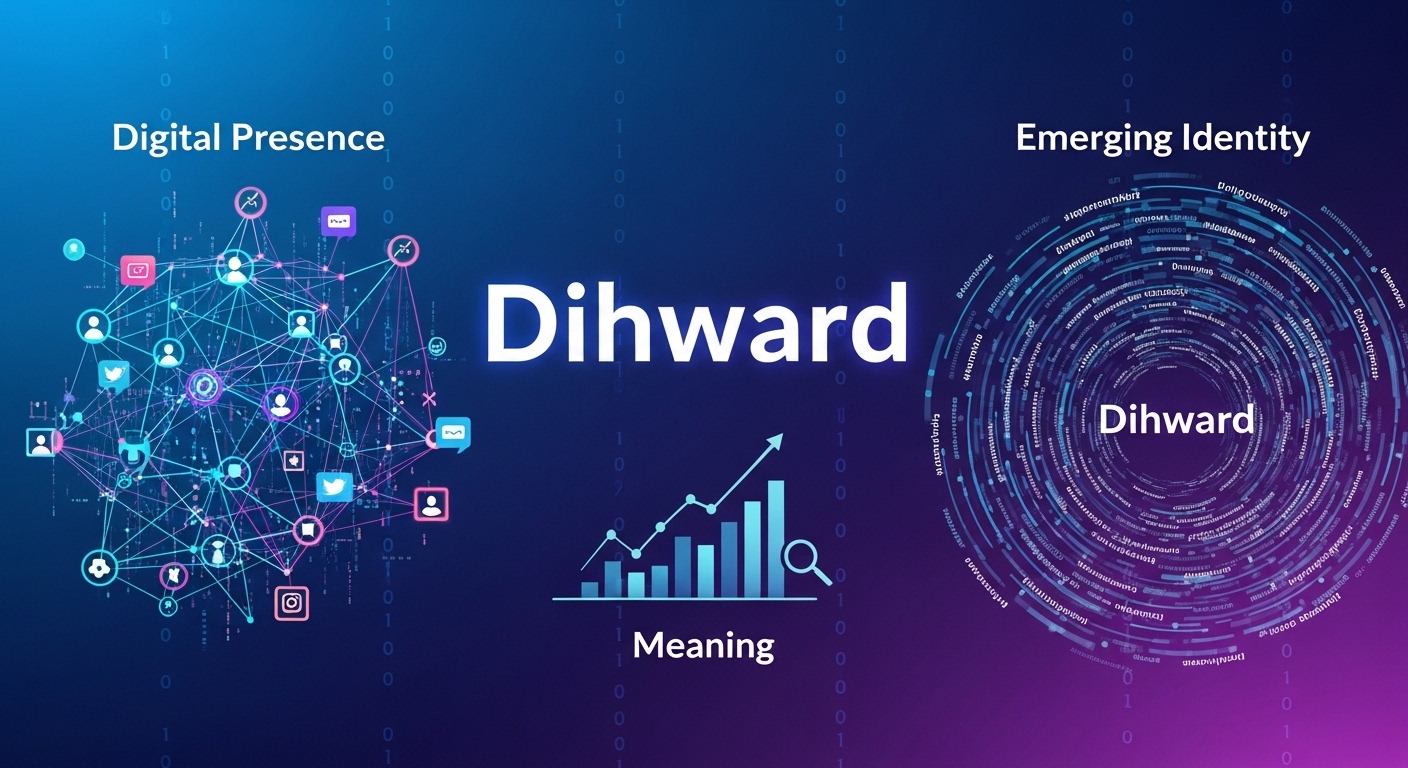
The keyword dihward has started appearing across search engines, digital logs, and online curiosity-driven queries, leaving many users wondering what it actually represents. At first glance, dihward does not clearly belong to any widely recognized brand, public figure, or established technology. Instead, it sits in a gray area of the internet where meaning is still forming, and interpretation depends heavily on context.
In today’s digital landscape, not every keyword begins with a fixed definition. Some, like dihward, emerge quietly and organically through fragmented usage, user searches, or unknown references in online environments. This creates a unique situation where the keyword itself becomes a subject of exploration rather than a clearly defined term.
Understanding dihward requires looking beyond traditional definitions and focusing instead on how modern internet culture shapes meaning, assigns relevance, and builds identity around unfamiliar terms.
Understanding Dihward and Its Emerging Digital Identity
The keyword dihward does not currently have an official or universally accepted meaning in public databases, corporate records, or academic references. This makes it part of a growing category of digital terms that exist primarily through search behavior rather than structured documentation.
In many cases, terms like dihward originate from partial data exposure, experimental naming conventions, or user-generated content that spreads without formal explanation. As a result, the keyword begins to live independently in search engines, even without a defined origin.
What makes dihward particularly interesting is that it reflects how modern users interact with unknown information. Instead of ignoring unfamiliar terms, users actively search for meaning, effectively giving life to the keyword through collective curiosity.
Possible Interpretations of Dihward in the Digital Landscape
Although dihward does not have a confirmed definition, it can be interpreted through several logical perspectives based on how similar internet terms evolve.
One possible interpretation is that dihward may function as a coded or internal identifier. In software development, internal modules, test environments, and experimental systems often use unique naming structures that are never intended for public release. When these names appear externally, they generate curiosity and search activity.
Another interpretation is that dihward could be a distorted or shortened variation of a longer phrase. In digital communication, especially across fast-moving platforms, words are frequently truncated, merged, or altered, creating new hybrid terms that later become searchable keywords.
A third interpretation is that dihward may simply be a random or synthetic keyword generated by automated systems. With the increasing use of AI tools, data simulation, and automated content generation, such terms can appear in datasets without human intent.
Why Dihward Is Being Searched Online
The rising interest in dihward is less about its definition and more about its mystery. In digital behavior analysis, unknown keywords often attract attention simply because they break expected language patterns.
When users encounter unfamiliar terms like dihward, especially in logs, URLs, or online discussions, their natural response is to search for meaning. This creates a feedback loop where curiosity drives visibility, and visibility further increases curiosity.
Search engines also play a role in amplifying such keywords. Once a term begins receiving repeated searches, even without clear meaning, it starts appearing in autocomplete suggestions, analytics dashboards, and keyword tracking tools. Over time, this gives dihward a form of digital presence that exists independently of its origin.
This phenomenon highlights an important shift in how the internet functions today. Meaning is no longer strictly created by definition; it is also shaped by search behavior and user interaction.
Dihward in the Context of Modern Digital Language Evolution
The internet has fundamentally changed how language develops. Words no longer need formal approval or dictionary definitions to gain relevance. Instead, they evolve through usage, repetition, and context.
Dihward fits into this pattern of emerging digital vocabulary. It demonstrates how quickly unknown terms can enter public awareness and begin circulating without clear explanation. In some cases, such words eventually stabilize into defined concepts. In other cases, they remain permanently ambiguous.
This evolution reflects a broader trend where digital communication is increasingly fluid. Social media platforms, decentralized content systems, and AI-generated text all contribute to a linguistic environment where meaning is constantly shifting.
In this environment, dihward becomes more than just a keyword. It becomes an example of how modern language adapts to uncertainty and rapid information exchange.
The SEO Perspective on Dihward and Undefined Keywords
From an SEO standpoint, dihward represents a unique type of keyword that challenges traditional optimization strategies. Normally, SEO relies on clear search intent, established definitions, and measurable user demand. However, ambiguous keywords like dihward operate differently.
Instead of having a single intent, dihward may attract multiple types of searches simultaneously. Some users may be looking for a brand, others for a definition, and others may simply be investigating a mysterious term they encountered online.
This creates an opportunity for content creators to build informational pages that focus on context rather than strict definition. Search engines increasingly reward content that explores meaning, related concepts, and user intent rather than only exact answers.
In this sense, dihward becomes part of a broader SEO strategy focused on semantic relevance. It connects to topics such as digital linguistics, keyword evolution, and search behavior psychology.
How Dihward Reflects Modern Internet Curiosity
One of the most interesting aspects of dihward is how it reflects human curiosity in the digital age. People are no longer passive consumers of information. They actively investigate, question, and interpret even the smallest fragments of data they encounter online.
This behavior is amplified by constant exposure to digital content. Users frequently encounter partial words, incomplete captions, or system-generated strings that feel meaningful but are not fully explained. Instead of ignoring them, users search for clarity.
Dihward represents this exact moment of curiosity. It is not necessarily important because of what it means, but because of what it triggers: the desire to understand.
This makes it a powerful example of how even undefined terms can gain significance through collective attention.
The Future of Keywords Like Dihward in Digital Ecosystems
Looking ahead, keywords like dihward are likely to become more common as digital systems continue to expand. With the rise of artificial intelligence, automated content generation, and large-scale data processing, more undefined or semi-random terms will enter online environments.
One possible future scenario is that search engines will become highly skilled at interpreting such ambiguous keywords. Instead of relying on exact definitions, they will analyze context, user behavior, and related queries to generate meaningful explanations.
Another future possibility is that undefined terms like dihward will become part of adaptive digital systems. Content platforms may automatically generate contextual pages that evolve based on search patterns and user engagement.
There is also the possibility that some of these keywords will eventually stabilize into real concepts. If enough users associate dihward with a specific idea, product, or meaning, it may gradually transform from an unknown term into a recognized digital entity.
Dihward and Its Place in the Broader Digital Ecosystem
Within the broader digital ecosystem, dihward sits in an interesting position. It is neither fully defined nor completely meaningless. Instead, it exists in a transitional space where interpretation shapes value.
This is increasingly common in a world driven by data systems, algorithmic generation, and global connectivity. The internet no longer requires fixed definitions for relevance. Instead, relevance is often created through interaction patterns and search demand.
In this sense, dihward is part of a new category of digital artifacts. These are terms that exist because they are noticed, searched, and discussed—even if their original purpose remains unclear.
Conclusion
The keyword dihward may not have a clear or established definition today, but its significance lies in what it represents. It reflects a digital environment where meaning is fluid, discovery is continuous, and curiosity drives interpretation.
Rather than being dismissed as an undefined term, dihward highlights how modern internet culture transforms even the smallest fragments of language into searchable concepts. It shows that in today’s world, meaning is not always created before use—it is often created through use.
As digital systems continue to evolve, keywords like dihward will likely become more common, shaping how we understand language, search behavior, and online identity. In many ways, dihward is not just a keyword—it is a reflection of how the internet itself now works.